About KeyRisks Registers
A risk register is not a list of worries. It is a structured way to understand what could hurt your organisation, why those risks exist, what might trigger them and what action should follow.
Our risk register framework helps business leaders move from scattered concerns to clear priorities, practical mitigation and accountable review.
Understand How Risk Forms
Stay Awake
Risk management is not about predicting the future. It is about spotting potential harm early enough to act while choices are still available.
Risk emerges when competing forces, such as growth versus control, interact with underlying vulnerabilities. Your risk register will help you recognise major areas of tension before they become disruptive.
Ask Smarter Questions
Better questions will encourage more useful answers:
- What pressures are acting on us?
- Where are they interacting?
- What weaknesses are being exposed?
- Under what conditions could this risk become active?
Your risk register will help you capture insight, support discussions, challenge assumptions and maintain resilience as conditions change.
See Risk more Clearly
Risk-based decision making is often complex. Especially when they are hidden inside budgets, deadlines and operational choices.
Your risk register will help make risk ownership, assumptions, trade-offs and emerging vulnerabilities visible.
Identify and Describe What Matters Most
Start Building Right Away
Your risk register should not take months to build.
In one focused workshop, you can probably identify 10–15 key risks within these five headline categories:
- People and Workplace Risks
- Business Continuity and Disruption Risks
- Legal and Regulatory Risks
- Technology Resilience Risks
- External Environment Risks
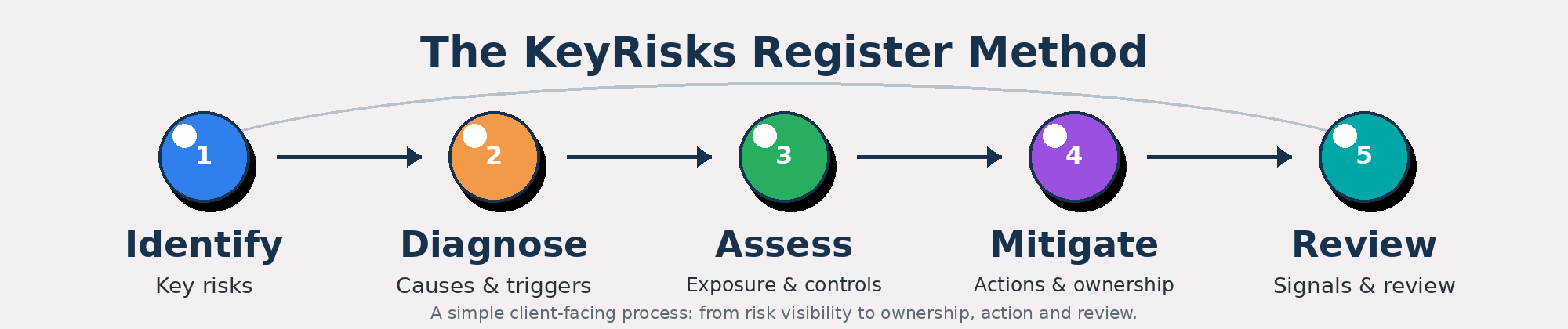
A step by step process will help you name risks clearly, understand root causes and triggers, expose competing forces, estimate credible impact, agree priority mitigation actions., assign ownership and set escalation triggers.
The outcome will be a working risk management register that you can easily build upon.
Assess Exposures and Set Priority Levels
Turning Signals into Insight
Major incidents are rarely sudden. They are usually preceded by near misses, workarounds, rising complaints, staff pressure, system delays and controls being bypassed.
Background indicators will tell you where pressure is building, while action indicators will show you when intervention is needed.
By recording key risk indicators, control confidence and response capacity, your risk register should identify deterioration before fragility becomes failure.
Likelihood, Severity and Prioritisation
Risk assessment will transform your list of concerns into a set of priorities.. It will also help you decide how much exposure you are willing to carry and what needs action now.
Likelihood will change as conditions shift, controls weaken, demand grows or assumptions fail. Severity must also be assessed in practical terms including cascade effects.
Turning Insight into Action
Mitigation Options
Mitigation is where your risk assessment becomes action. It means deciding whether to accept, reduce, avoid or transfer a risk, with each choice clearly owned, documented and aligned to risk appetite.
In practice, mitigation is often a blend rather than a single action. You may reduce likelihood through better controls, detect deterioration through KRIs, transfer financial exposure through contracts or insurance and consciously accept what remains.
Understanding the Cost of Action and Inaction
Mitigation costs are rarely limited to capital spend. They include operational overhead, management time, disruption, lost opportunity and ongoing increases in the cost of working.
The cost of prevention is usually visible and immediate. The cost of failure is often delayed, larger and underestimated.
Good mitigation decisions compare the cost of action with the cost of carrying the risk.
Ownership, Monitoring and Review
Risk ownership is continuous stewardship. A risk owner should understand why the risk exists, monitor causes and triggers, escalates when thresholds are crossed and make sure control actions remain effective.
Review frequency should reflect how quickly the risk could change and how much confidence exists in current controls. Every review should ask: what has changed that affects our assumptions, exposure or response?